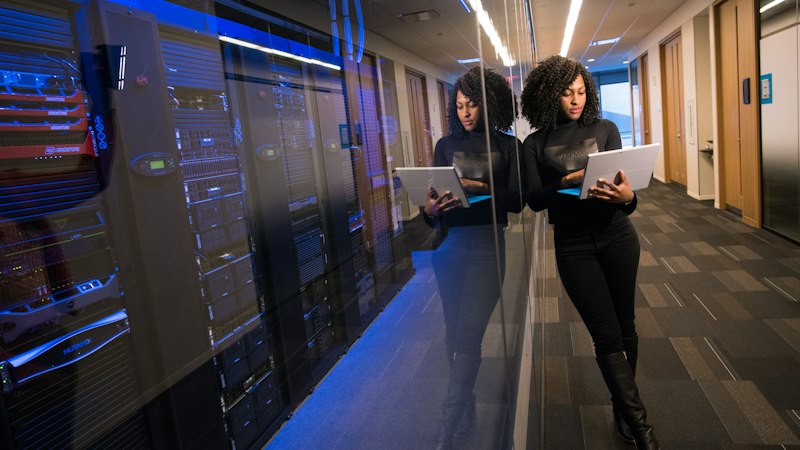
Everyone talks about AI as if it exists purely in the cloud. We discuss models, compute, and parameter counts, but we rarely talk about the glass cables required to actually deliver these answers to a user without freezing.
When you build an ISP in Kashmir, you start seeing the internet differently. You stop seeing it as software and start seeing it as a strictly physical logistical challenge. AI is forcing the rest of the world to see it that way too.
The Compute Illusion
The tech industry has spent the last two years obsessed with data centers. We talk about Nvidia GPUs, massive cooling systems, and gigawatt power grids. We treat the intelligence as the only hard part of the equation. But generating an answer in a data center is only half the problem. Delivering that answer in real time is the other half.
Right now, we are deploying AI agents that can think, reason, and speak to customers on the fly. When a customer calls a business and speaks to a voice agent, that agent must transcribe the audio, process it through a large language model, synthesize a voice response, and send it back. All of this must happen in milliseconds. If this process takes more than a second, the conversation feels unnatural. The illusion of intelligence breaks.
This is where the physics of the last mile become a hard limit. You can buy the fastest GPUs on earth, but if your customer is on a congested wireless connection, the AI will stutter. Latency is the silent killer of autonomous agents. The most advanced software in the world is entirely dependent on the quality of the local connection.
Why AI Needs Fiber
This is exactly why we are seeing a global shift toward viewing fiber internet as the foundational layer of the AI economy. Wireless networks are incredible for mobility, but they are subject to the brutal laws of physics. Shared spectrum means that at 8 PM, when everyone in your neighborhood streams video, your latency spikes and your packets drop.
Fiber optics operate differently. They send light down a dedicated strand of glass. It is symmetrical, it is unaffected by weather, and the latency is practically zero. For an AI agent to feel like a real person, or for an autonomous workflow to execute without timing out, it needs this kind of stable, low-latency pipeline.
When we lay cable for ViberNet across Srinagar, we are not just giving people faster Netflix. We are laying the physical tracks that will allow local businesses to run AI workflows. We are building the local foundation for a global shift. The software revolution is bottlenecked by the hardware deployment, and fiber is the only material capable of handling the load.
Get new posts by email, daily-ish writing on ISP economics, AI in production, and building in Kashmir.
The Edge Computing Shift
Because latency is so critical, the industry is pushing compute closer to the user. Instead of sending every request to a massive data center in Mumbai or Virginia, companies are building smaller edge nodes closer to Tier-2 and Tier-3 cities. The goal is to process the data as close to the origin as possible.
But edge computing only works if the edge is connected. An edge data center in Kashmir is useless if the last mile to the customer's house is unreliable. The AI revolution will not be evenly distributed. It will strictly follow the fiber maps. Where the glass goes, the capabilities follow.
This creates a massive opportunity for local infrastructure builders. Government schemes like BharatNet are doing the heavy lifting of bringing the backbone to rural areas. But the final connection to the home is still a localized, messy, operational challenge. It requires people who know the streets, the poles, and the local bureaucracy. The last mile cannot be solved from a boardroom in California.
Infrastructure as Destiny
It is easy to get caught up in the hype of what AI can do. At OpenLoop, we build custom workflows for clients every day, and the capabilities are genuinely staggering. It feels like magic. But as builders, we have to stay grounded in reality.
The reality is that software relies on hardware. And the hardware relies on someone putting on a hard hat, digging a trench, and splicing glass. If you want to understand where the AI economy is actually growing, do not look at the software hubs. Look at where the fiber is going.
Infrastructure is destiny. If we want to participate in the next decade of technology, we have to build the roads it travels on. That is the unglamorous, difficult, and absolutely essential work of the next ten years.