Spring in Kashmir - Build in Public Campaign by Mehran Shahmiri in Kashmir
Campaign

Spring 2026.

30 Days Build-in-Public Campaign.

Top Takeaways

  • Relevance is the Only Metric that Pays
  • Software Must Be Born from Operations
  • Honesty is a Strategy

Day 1: The Kickoff

Campaign Day 1
Day 1: The Kickoff - Build in Public Campaign by Mehran Shahmiri in Kashmir

I run a fiber internet company called ViberNet in Srinagar, Kashmir.

We lay fiber. We connect homes. We handle billing, support, field operations.

And for 2 years, I wrote every line of software that runs it.

The NOC portal. Customer onboarding. Payment flows. RADIUS integrations. OLT monitoring. A Flutter app for customers.

Not because I couldn't hire someone. Because no off-the-shelf software understood how an ISP in Kashmir actually works.

So I built it.

That experience, operating a business AND building its software, is what I now bring to other businesses through my agency, OpenLoop.

Over the next 30 days, I'm going to build in public. Share what I'm working on, what I've learned, and how I think about software as an operator, not just a developer.

Follow along if that sounds useful.

BuildInPublic ISP SoftwareDevelopment Kashmir Founder
Tip: Day 1 of 30. Introduce yourself + announce the campaign. High reach expected, post early morning.

Day 2: Early Wins

Campaign Day 2
Day 2: Early Wins - Build in Public Campaign by Mehran Shahmiri in Kashmir

Most ISPs in India use 3 different disconnected tools to manage customers. We use one. We built it.

Yesterday's post hit 20,000 impressions and added 200 followers in under 20 hours. That tells me something, there are a lot of people who've felt the pain of disconnected tools, whether in ISPs or in any business.

So let's go deeper.

When I started ViberNet, I looked at what other ISPs use to manage operations.

  • Billing software from one vendor.
  • Network monitoring from another.
  • Customer support on WhatsApp.
  • Field ops tracked in Excel.

Nothing talked to each other. Every piece of data lived in a different place.

So I built a unified Network Operations Centre that handles:

  • → Customer management
  • → RADIUS authentication (FreeRADIUS integration)
  • → Static IP assignment
  • → Revenue projections and financials
  • → OLT monitoring (fiber signal quality, per-port)
  • → Field engineer workflow
  • → Payment collection via PayU

One system. One source of truth.

This is what good software does for a business, it removes the friction between knowing something and acting on it.

Most businesses I talk to are still living in the "3 disconnected tools" world. You don't have to be.

A note on what I'm doing here:
This is Day 2 of a deliberate 30-day build-in-public campaign I'm running on LinkedIn.
Every day for 30 days, I'm sharing what I'm actually building, at ViberNet (our ISP) and at OpenLoop (our software agency).

Real work. Real decisions. Real lessons.
No motivational fluff. No recycled frameworks.

Tip: When a post blows up, your next post is your highest-stakes one. New followers are watching to see if you're consistent or a one-hit wonder. Don't go quieter, go deeper. Specificity is what converts a curious follower into a loyal one.

That's what I'm doing with this post right now.

ISP NetworkOperations CustomSoftware OpenLoop BuildInPublic

Day 3: Zero VC Funding

Campaign Day 3
Day 3: Zero VC Funding - Photo 1 - Build in Public Campaign by Mehran Shahmiri in Kashmir Day 3: Zero VC Funding - Photo 2 - Build in Public Campaign by Mehran Shahmiri in Kashmir

Both photos are from September 2025

We launched a fiber ISP in Kashmir with ₹0 in VC funding. Here's how the business actually works.

No VC. No angel round. No startup accelerator.

ViberNet runs on customer revenue, operator margins, and infrastructure that compounds over time.

Here's the rough economics of a fiber ISP:

  • → You lay fiber once. It lasts 10+ years.
  • → Every new customer on that fiber is near 100% margin after ops.
  • → The asset appreciates as the area develops.

But the hard part isn't the fiber. It's the operations.

Customer acquisition → KYC → installation → billing → support → retention.

Every step is a place where things break, customers churn, and money leaks.

We built software for every one of those steps. Not because it was fun. Because every broken step costs money.

The lesson: software is an operational investment, not an expense.

If it removes friction, it pays for itself.

That's true for an ISP. It's true for almost any business with operational complexity.

This is Day 3 of my 30-day build-in-public series. Every day I share what I'm actually building, at ViberNet and our software agency. No fluff. Follow along.

Tip: Not every post will blow up. And that's fine. One post reaches 20k, the next reaches 1k. What matters is the cumulative signal you send to the algorithm and to your audience: that you show up every day regardless.

Consistency is the strategy. Virality is just a side effect.
Bootstrapped ISP OperationsManagement Kashmir Founder BuildInPublic

Day 4: The Degree Dilemma

Campaign Day 4
Day 4: The Degree Dilemma - Photo 1 - Build in Public Campaign by Mehran Shahmiri in Kashmir Day 4: The Degree Dilemma - Photo 2 - Build in Public Campaign by Mehran Shahmiri in Kashmir

I'm a CS student in semester 4. I also run two companies. Honestly? I'm not sure the degree is worth it, for me.

Let me be precise about what I mean.

I'm not saying education is useless. I'm saying a CS degree, for someone already running production infrastructure and shipping real software, is a poor use of 4 years.

Here's my reality:

  • When I study networking protocols in class, I already understand them, because I've debugged them at 2am when a router config broke and 200 customers lost internet.
  • When I study databases, indexes aren't abstract, I've watched queries time out on a live FreeRADIUS database serving real users.

The classroom isn't teaching me anything the field hasn't already taught me better, faster, and with actual consequences.

So why am I still enrolled?

Well, social pressure, family expectations, and the nagging fear (not mine, the people close to me fear this) that the one time I need that piece of paper, I won't have it.

Not exactly a compelling academic mission.

I think the degrees, especially in CS, made sense when information was scarce and credentials were the only signal of competence. Neither of those is true anymore.

What signals competence now: things you've built, problems you've solved, systems that run in production with your name on them.

I have those. The degree is catching up.

Day 4 of my 30-day build-in-public series. Every day I share what I'm actually building, at ViberNet and at my software agency.

Tip: Controversial but honest beats safe and forgettable every time. The goal isn't to avoid disagreement, it's to say something true that other people are thinking but not saying. That's what gets shared. That's what builds a real audience.

Say the thing. Own it.
BuildInPublic StudentFounder Kashmir Founder Education

Day 5: Custom CRM ROI

Campaign Day 5
Day 5: Custom CRM ROI - Build in Public Campaign by Mehran Shahmiri in Kashmir

I built a complete customer management system for a fiber ISP in 6 weeks. Here's what it replaced, and what it saved.

Before we built our own software at ViberNet, this is how we onboarded a new customer:

  • → Field engineer visits. Writes details on paper.
  • → Papers come to office. Someone types them into a spreadsheet.
  • → KYC done manually. Filed physically.
  • → Installation scheduled over WhatsApp.
  • → Activation is a phone call to the network team.

2 people. 2 hours. Per customer.

We were doing 30+ activations a month. That's 40-90 staff hours, every month, on a process that added zero value.

So we built a system that handles it end to end:

  • → Engineer captures lead, KYC photos, and GPS location on mobile, on-site
  • → Payment collected digitally before installation
  • → KYC reviewed and approved in the portal
  • → Technician activates with OTP verification
  • → CAF document auto-generated and stored on cloud

Time per activation now: under 30 minutes.

That's 90+ hours saved every month. Permanently. From a one-time software investment.

We built this for ourselves. We now build it for other businesses.

If your team is spending hours every week on a process that software could handle, I'd like to talk. DM me and we'll figure out together whether it's worth building.

Day 5 of my 30-day build-in-public series — sharing what I'm building at ViberNet and OpenLoop every day.

Marketer's tip of the day: Direct beats clever when you need results.

Tell people exactly what you do, exactly who it's for, and exactly how to reach you. The ones who need it will come. The ones who don't will keep reading anyway. Clarity is the most underrated sales tool.
CustomSoftware OpenLoop BusinessAutomation ISP BuildInPublic SoftwareAgency

Day 6: Pricing by Value

Campaign Day 6
Day 6: Pricing by Value - Build in Public Campaign by Mehran Shahmiri in Kashmir

The difference between a ₹10,000 project and a ₹1,00,000 project is not the code. It's this.

Most business owners think software is priced by complexity.

It isn't. It's priced by the value of the problem it solves.

Here's the clearest example I know:

Client A calls and says: "I need a website."

Client B calls and says: "My field engineers spend 3 hours a day on paperwork. I need that gone."

Same developer. Same technical effort. Completely different project value.

Because Client B understands what the problem is actually costing them.

Let's do the math Client B did:

  • → 4 executives × 3 hours/day on manual paperwork
  • → That's 12 executive-hours lost every single day
  • → At even ₹200/hour fully loaded cost, that's ₹2,400/day
  • → ₹72,000/month. Every month. Just gone.

A ₹60,000 software project that eliminates that pays for itself in 13 days.

That's not an expense. That's the highest-ROI investment that business makes all year.

This is the conversation I have with every client before we discuss price at OpenLoop.

Not "what do you want built" but "what is this problem costing you right now?"

Once you answer that honestly, the budget conversation becomes very simple.

If you're a business owner sitting on a process that your team works around every day, manual, slow, error-prone, I'd genuinely like to understand it.

DM me. No pitch, no pressure. Just that one conversation.

Day 6 of my 30-day build-in-public series, sharing what I'm building at ViberNet and OpenLoop every single day.

Marketer's tip of the day: Never sell the product. Sell the cost of not having it.

Most buyers already feel the pain, they just haven't quantified it. When you do the math for them, you don't need to convince anyone of anything.

The numbers close the deal. You just have to surface them.
OpenLoop CustomSoftware BusinessROI SoftwareDevelopment BuildInPublic SoftwareAgency

Day 7: Week 1 Recap

Campaign Day 7
Day 7: Week 1 Recap - Photo 1 - Build in Public Campaign by Mehran Shahmiri in Kashmir Day 7: Week 1 Recap - Photo 2 - Build in Public Campaign by Mehran Shahmiri in Kashmir

Week 1 down. Here's what actually happened.

6 days ago I started a 30-day build-in-public series.

Here's the honest numbers from week 1:

  • → Day 1 post hit 50,000 impressions. 200+ followers added in under 24 hours.
  • → Every other post averaged 3,000–4,000 impressions
  • → 30–50 likes per post consistently
  • → Multiple inbound conversations started

Here's what I think actually happened:
People are tired of LinkedIn content that's polished, vague, and says nothing. When someone shows up and talks about real infrastructure, real numbers, real operational problems, it stands out because almost nobody does it.

That's the only strategy here. Be specific. Be honest. Show the actual work.

Here's what I said I'd do this month:

  • → Expand ViberNet's franchise partner system
  • → Ship 2 client projects through OpenLoop
  • → Write 30 posts about what I learn along the way

Status after week 1: all three in motion.

Why I'm doing this publicly:

Building in public creates accountability. If I say I'm shipping something, and now almost 2000 people can see my feed, I'm more likely to actually ship it.

It also forces clarity. Explaining what you're building to someone outside your head is harder than it sounds. It surfaces gaps in your own thinking that you'd otherwise miss.

And it builds trust, not because I'm trying to sell you something, but because consistent honest output is the only credential that can't be faked.

Week 2 starts tomorrow. It gets more technical.

If you're a business owner who's been wondering whether custom software could solve an operational problem you're living with, stay around. That's exactly where this is heading.

Marketer's tip of the day: Recap posts are underrated.

They do three things at once: reward your existing audience for following along, re-onboard new followers who missed earlier posts, and signal to the algorithm that your content has sustained engagement over time.

Do a weekly recap. Always. It compounds.
BuildInPublic WeekInReview OpenLoop ViberNet Founder Kashmir

Day 8: When to Build Custom

Campaign Day 8
Day 8: When to Build Custom - Build in Public Campaign by Mehran Shahmiri in Kashmir

Not every business needs custom software. Here's an honest framework for figuring out if yours does.

I turn down projects regularly.

Not because we're too busy, but because bad-fit software projects waste everyone's time and money. The client ends up with something they don't use. We end up with a case study we can't be proud of.

So here's the framework I use before taking on any project:

You don't need custom software if:

  • → Your process is simple and an off-the-shelf tool already covers it
  • → You're pre-revenue and still figuring out your model — build the business first, then systematize it
  • → The problem you're solving changes every few weeks — software needs stable problems to be worth building

You do need custom software if:

  • → You're managing a process that touches multiple people and has several handoff points
  • → You're running critical business data through Excel or WhatsApp, and it's costing you accuracy or speed
  • → You've outgrown a generic tool and you're hacking it to do things it wasn't built for
  • → You have a competitive advantage you want to protect, and your current vendor owns your data

The sweet spot:
A process you run repeatedly. That costs you real money or time when it breaks. That won't change fundamentally for the next 1 to 2 years.

That's the project worth building. Everything else, wait.

I'm sharing this because most agencies won't tell you when you don't need them. I'd rather have an honest 20-minute conversation that saves you ₹50,000 than take a project that shouldn't exist.

If you have a process you're not sure about, DM me. I'll tell you straight whether it's worth building or not.

No pitch. Just an honest answer.

Day 8 of my 30-day build-in-public series; sharing what I'm building at ViberNet and OpenLoop every day.

Marketer's tip of the day: Telling people when NOT to buy from you is the most powerful trust signal in sales.

It immediately separates you from every agency that says yes to everything. It makes every "yes" you give afterwards worth ten times more.

Honesty is a positioning strategy. Use it deliberately.
CustomSoftware OpenLoop BusinessAutomation SoftwareAgency BuildInPublic Founder

Day 9: The MyViberNet App

Campaign Day 9
Day 9: The MyViberNet App - Build in Public Campaign by Mehran Shahmiri in Kashmir

We're building a mobile app for ViberNet customers. Here's what the decisions look like before a single user touches it.

Most people share apps after they ship.
I'm sharing this one while it's still being built, because the interesting decisions happen before launch, not after.

The app is called MyViberNet. It's the customer-facing mobile app for our fiber ISP. Here's what it needs to do:

  • → OTP-based login — no passwords, no reset flows, no support tickets
  • → View current plan and expiry
  • → Check usage
  • → See transaction history
  • → Recharge directly from the app

Simple on paper. The decisions underneath are not.

Why Flutter:
We could have built a web app and called it done. We chose Flutter because the widget system lets you build something that feels native and looks good, without a dedicated designer. For a lean team, that matters.

Also: one codebase, Android and iOS. That's Flutter's main strength.

The decision I'm most confident about:

  • OTP login. No passwords.
  • Our customers are not all technical. A password reset flow creates confusion, support calls, and churn. An OTP to their phone number just works.
  • Design for the actual user, not the ideal user.

The thing I'm watching most carefully:

  • The backend. Laravel Sanctum handles auth, but expired token handling on the API side is where mobile apps quietly break. We are building that error handling before the happy path is even complete.

Most bugs in mobile apps aren't in the app. They're in the API.

Day 9 of my 30-day build-in-public series; sharing what I'm actually building at ViberNet and OpenLoop every day.

Marketer's tip of the day: Don't wait until you ship to talk about what you're building.

The journey is more interesting than the destination. People who follow the build feel ownership over the outcome, they become your first users, your first advocates, and your most loyal audience.

Build out loud. From day one.
Flutter MobileApp BuildInPublic Laravel OpenLoop ViberNet

Day 10: Franchise Architecture

Campaign Day 10
Day 10: Franchise Architecture - Build in Public Campaign by Mehran Shahmiri in Kashmir

ViberNet is expanding through franchise partners. I'm building the system to manage it. Here's what that actually looks like.

Growth creates complexity.

When ViberNet was one location, one team, everything lived in one portal and one person's head.
Now we're expanding through franchise partners. Each partner operates part of our network under the ViberNet brand, handles their own customers, collects revenue, and shares margins with us.

Our existing software wasn't built for that. So I'm building a franchise management system from scratch.

What it needs to handle:

  • → Each partner sees only their customers, collections, and outstanding amounts
  • → We get a consolidated view across all partners
  • → Commission calculations automated, no manual reconciliation
  • → Partners can never see each other's data

The architecture:
Single Laravel app. Multi-tenant by partner_id. Every query scoped. One database, separate databases per partner would add ops complexity that isn't justified at this stage.

The right architecture isn't the most elegant one. It's the one you can actually operate.

The hardest part:
Not the code. It's modeling the business logic before writing a single line.
Get the data model wrong and you rebuild everything six months later. That expensive week of thinking upfront is happening right now.

On that note, if you're based in J&K and interested in becoming a ViberNet franchise partner, we're actively onboarding. DM me or write to hey@vibernet.in.

Day 10 of my 30-day build-in-public series, sharing what I'm actually building at ViberNet and OpenLoop every day.

Marketer's tip: Share the thinking, not just the outcome. Decisions in motion are more compelling than results in hindsight, people engage with things that aren't finished yet.
BuildInPublic Business FranchiseManagement ViberNet OpenLoop SoftwareDevelopment

Day 11: Local First Moat

Campaign Day 11
Day 11: Local First Moat - Build in Public Campaign by Mehran Shahmiri in Kashmir

Operating a business in Kashmir taught me something Silicon Valley won't tell you.

The tech narrative is: build global from day one. Think big. Scale fast.

But here's what the last two years in Kashmir taught me:

Local markets with real operational challenges are underserved. And if you serve them well, you become very hard to replace.

ViberNet doesn't compete with Jio or Airtel on price. We can't, and we don't try.

We compete on presence.

  • Knowing which area needs fiber next.
  • Trying to fix issues as fast as we can.
  • Building real relationships in a place where that matters most.

We're building this every single day.

And here's the part most people miss:

This is scalable.

Not because you expand blindly,
but because you build deep, strong systems in one market… and then repeat them.

Kashmir has 15 million people. It's growing fast. Internet usage is rising.

More people are working online than ever before.

And there are very few local companies that truly understand how things work here, on the ground.

We're working to become one of them.

That's the opportunity.

It requires being here, consistently, which is exactly why most people don't do it.

The companies that win in markets like this won't be the ones that show up with money and a copied playbook.

They'll be the ones who stay, build, learn, and earn trust.

That's what we're doing.

The foundation is being built. Systems are coming together. People are starting to know us.

What comes next is scale, built on systems, not shortcuts.

Day 11 of my 30-day build-in-public series; sharing what I'm building at ViberNet and OpenLoop every day.

Marketer's tip of the day: The strongest positioning isn't “we're the best.”
It's “we're actually here, doing the work.”

Presence, when combined with systems, becomes a moat, and a growth engine.

If you're building in a place others ignore, talk about it. That's your advantage.
ViberNet Kashmir BuildInPublic LocalFirst Infrastructure Founder

Day 12: Lessons from 3 Businesses

Campaign Day 12
Day 12: Lessons from 3 Businesses - Build in Public Campaign by Mehran Shahmiri in Kashmir

Lessons from building 3 businesses before turning 22 in Kashmir.

ViberNet. Open Loop. And one before both of them.
Here's what each one taught me:

ViberNet — infrastructure is the ultimate long game.
Fiber takes time. You lay cable, train engineers, build relationships, and wait. The returns are slow at first, then they compound forever.

Every meter of fiber we've laid will generate revenue for the next 20 years. Nobody can replicate it overnight. That defensibility takes patience most people aren't willing to have.

You also can't enter Kashmir from a laptop in Bangalore. You have to be here. We are.

OpenLoop — software is leverage, but only if you understand the business first.
The mistake most developers make is thinking the product is the code.

It isn't. The product is the outcome the client gets. The code is just how you deliver it.

Every project that went well started with understanding the business deeply. Every project that went sideways started with a brief and a deadline.

Superfast — unit economics before everything else.
I ran the numbers forward, backward, and sideways.

At 100 customers it didn't work. At 1,000 it didn't work. At the highest scale Kashmir could realistically support, still didn't work.

So I stopped. Not because I failed to execute. Because the math didn't work and I was honest enough to accept that early.

Knowing when to walk away is the most underrated skill in business.

The common thread:
Real businesses solve real problems for real people. Not addressable markets in pitch decks. Real pain that people will actually pay to remove.

That filter has never failed me.

Day 12 of my 30-day build-in-public series.

Marketer's tip of the day: Talking about failure publicly is the fastest way to build real trust. Every founder has one. Almost none talk about it.
Say the hard thing. It travels further than the easy thing every time.
Founder Kashmir BuildInPublic OpenLoop ViberNet Entrepreneurship

Day 13: Self-Hosted AI Ceilings

Campaign Day 13
Day 13: Self-Hosted AI Ceilings - Build in Public Campaign by Mehran Shahmiri in Kashmir

We tried to build our own AI inference server. It didn't work the way we hoped. Here's what we learned.

Every startup building AI features hits the same wall eventually.

The product works. Users love it. And then the cloud AI bill arrives.

Per-token pricing sounds harmless at small scale. At real scale, thousands of requests a day, embedded in product features that run continuously, it becomes a variable cost that grows exactly as fast as your traction does.

The better the product performs, the more it costs to run.

So we tried to solve it ourselves.

We spun up a KVM virtual machine. 20-core Xeon, 128GB RAM. Installed Ollama, Open WebUI, exposed it via Cloudflare tunnel. CPU-only inference, no GPU.

It worked for light queries. Simple summarization, short classification tasks, quick lookups.
Then we pushed it harder.

Complex document analysis. Multi-step reasoning. Anything that required the model to actually think rather than pattern-match.

The server couldn't handle it. Response times jumped to 40-60 seconds. The experience broke. For a product feature, that's the same as not working at all.

So we made a different call.

We stayed on cloud APIs for anything latency-sensitive and complex. We kept the local server for lightweight, high-frequency tasks where speed requirements are low and volume is high.

Hybrid. Not pure cloud. Not pure local.

The lesson wasn't “self-hosted AI doesn't work.” The lesson was more precise than that:

CPU inference has a real ceiling. Below that ceiling it's a genuinely good economic decision. Above it, you're fighting physics, and physics wins.

Know your ceiling before you architect around an assumption.

The broader principle still holds:
The companies that will have durable margins in the AI era are the ones that understand their inference costs deeply, not the ones blindly routing everything through the same three providers, and not the ones overcorrecting into infrastructure they can't sustain.

The right answer is almost never all or nothing. It's knowing exactly where each approach breaks down.

Day 13 of my 30-day build-in-public series, sharing what I'm actually building at ViberNet and OpenLoop every day. Including the things that don't work.

Marketer's tip of the day: Sharing a failure with a precise lesson attached is ten times more valuable than sharing a success.

Show your thinking. Especially when it's uncomfortable.
AI BuildInPublic OpenLoop Infrastructure Founder Ollama MachineLearning

Day 14: Week 2 Recap

Campaign Day 14
Day 14: Week 2 Recap - Build in Public Campaign by Mehran Shahmiri in Kashmir

2 weeks of building in public. Here's everything; the numbers, what's working, and where this is going.

14 days ago I started posting every day about what I'm building.

No ad spend. No paid promotion. Just showing up daily and being honest about the work.

Here's what happened:

  • → 49,796 impressions
  • → 24,314 unique members reached
  • → 817 engagements
  • → 71 comments
  • → Nearly 500 new followers

We went from 1,600 followers to this in just 14 days. From Kashmir.

It proved something important. People want to see real builders sharing real work, real lessons, and real numbers. Not recycled advice.

And that audience exists everywhere, even in places most people ignore.

Here's what I'm actually building for context:

ViberNet — a bootstrapped fiber ISP operating in Srinagar, Kashmir.

Physical infrastructure. Franchise partners. A software stack we built ourselves. Customers who pay monthly for reliable internet.

Every meter of fiber we lay becomes a long-term revenue-generating asset. We don't rent infrastructure, we own it.

OpenLoop — a software agency that builds operational software for businesses with real complexity.

Born directly from building ViberNet's own stack. Every tool we sell, we've already built and run ourselves.

Two businesses. One feeds the other. Both growing.

I've been intentionally vague about one thing in this series:

Where this goes from here.

ViberNet is at the stage where the foundation is solid, the model is proven, and the next constraint is straightforward: capital to expand faster than organic revenue allows.

Kashmir is not a small market. It's an underserved one. Those are very different things.

The fiber we lay today has no serious local competitor. The software we've built has no off-the-shelf equivalent for this market.

If you're someone who thinks in terms of defensible assets, recurring revenue, and underleveraged markets, I'd genuinely like to have a conversation.

Not a pitch. Just a conversation between people who think about the same kinds of things.

Day 14 of my 30-day build-in-public series. Week 3 starts tomorrow, it gets more specific.

Marketer's tip of the day: Data is the most persuasive sentence you can write.

Let the number do the work. Your job is just to put it in front of the right people.
BuildInPublic ViberNet OpenLoop Kashmir Founder Infrastructure Entrepreneurship

Day 15: Launching SuperDash

Campaign Day 15
Day 15: Launching SuperDash - Build in Public Campaign by Mehran Shahmiri in Kashmir

The worst part about running an ISP isn't the outages.

It's the 15 minutes you spend SSHing into MikroTik, digging through RADIUS logs, pinging the OLT, just to answer one customer's question.

Then you look up and there are 40 more tickets. That's not an outage problem. That's a visibility problem.

At ViberNet, we lived it for some time. Billing in Excel. Renewals tracked manually. Churn discovered weeks after it happened. Revenue leaking every month, quietly, invisibly, until the end-of-month statement hit like a slap.

So we built our way out.

SuperDash is the NOC dashboard I wish existed when I was running operations blind.

Built specifically for ISPs on FreeRADIUS, MikroTik, and EPON/GPON:

  • Live subscriber map — PPPoE sessions, IPs, uptime, MAC addresses, real time
  • One-click RADIUS CoA disconnect — no SSH, no terminal, no wasted minutes
  • CPE diagnostics in seconds — OLT optical power, session history, disconnect patterns
  • OLT management — live ONU table, catch signal degradation before it becomes downtime
  • Finance and churn intelligence — renewal alerts, revenue projections, automatic churn risk scoring
  • Sarah AI — ask her why a subscriber keeps dropping. She'll tell you which fiber splice to check.

One screen. Everything your NOC needs. Under 30 minutes to set up.

We don't sell this from a whitepaper. We run it. Every day. On our own network.

If you're still doing the SSH-and-spreadsheet NOC, I'd like to show you what the other side looks like.

Visit at superdash.one or DM me.

Day 15 of my build-in-public series, where I show what I am doing at ViberNet (Our ISP) and OpenLoop (Our software agency).

Marketer's tip: The strongest launch copy isn't an announcement. It's a problem statement so accurate your ideal customer thinks you've been watching them work. Write the pain first. The product is just the relief.
SuperDash ISP BuildInPublic OpenLoop SaaS NetworkOperations FreeRADIUS MikroTik

Day 16: Healing the Network

Campaign Day 16

A few days ago our internet went down. Every customer. Every line. Here's what that night taught me.

No warning. Just, gone.

Phones started ringing within minutes. Customers frustrated. Staff scrambling. Every escalation path hitting the same wall.

First major downtime in all time.

We stayed calm, communicated honestly, and when it was over we waived charges for everyone who lost service. No fine print. You didn't get what you paid for, so you don't pay.

The line came back. But that night sitting with the chaos, I kept thinking about something much bigger than the outage.

There are villages where people have never had reliable internet. Students uploading assignments when they occasionally get signal. Businesses cut off from the economy the rest of India takes for granted.

We want to reach them. ₹249/month. Fiber where fiber has never gone.
Not because it's the most profitable move. Because connectivity is not a luxury and someone has to believe that enough to actually do it.

The network went down because a human decision at a provider failed. A misconfiguration. A missed alert.

What if the network could heal itself?

That's what we're building toward at OpenLoop. AI that doesn't just monitor networks, AI that understands them well enough to diagnose, reroute, and recover without waiting for a human to SSH in at 2am.

Kashmir sits at the geographic heart of North India. Himalayan winters that make natural cooling effortless. The natural home for data centers, peering infrastructure, the backbone the entire northern region will need as it develops.

Nobody is thinking about Kashmir this way yet.

That's exactly why we are.

I'm 21. Bootstrapped. Building from Srinagar.

The downtime was a reminder that we're still early. The work is daily and unglamorous and occasionally chaotic.

But the vision is clear.

And clear vision, more than anything else, is what survives the chaos.

Day 16 of my 30-day build-in-public series.

Marketer's tip of the day: The most magnetic personal brand isn't built on success stories. It's built on honest struggle and unreasonable vision existing in the same person at the same time.

Show both. Always both.
BuildInPublic ViberNet OpenLoop Kashmir Founder Infrastructure Vision

Day 17: The WhatsApp Problem

Campaign Day 17

If your business runs on WhatsApp groups and Excel sheets, you don't have an operations problem. You have a software problem.

And it's costing you more than you think.

Every message that should be a workflow. Every spreadsheet that should be a database. Every “please check the group” that should be an automated alert.

It adds up.

Not in a way that shows up on a balance sheet. In a way that shows up in missed renewals, slow decisions, staff doing work that a system should be doing, and customers who fall through the cracks because nobody got the notification.

The businesses I've worked with didn't know how much it was costing them until we mapped it out. The number is always uncomfortable.

The fix is almost never complicated. It's just software that understands how your business actually works, not a generic tool you're hacking to fit.

That's what we build at OpenLoop.

If you're running a business on WhatsApp and Excel and you've been thinking “there has to be a better way”, there is.

DM me. Let's map it out together. No obligation, just clarity.

Day 17 of my 30-day build-in-public series.

Marketer's tip of the day: The best client attraction content doesn't describe your service. It describes your client's Tuesday morning so accurately that they feel understood before you've said a single word about what you do.

Empathy before offer. Always.
OpenLoop CustomSoftware BusinessAutomation BuildInPublic SMB Founder

Day 18: Operations vs Software

Campaign Day 18

Over the last few weeks, I've been sharing what I'm building at ViberNet, our internet service provider in Kashmir, and at OpenLoop, where we help businesses build software around real operational problems.

One thing I've noticed:

Most businesses don't actually have a software problem.
They have an operations problem that software is supposed to solve.

But the first question clients usually ask is:

“How much will it cost?”
“I need a billing portal. Budget is ₹8,000.”
Fair enough.

But ₹8,000 usually buys you:
A template. Your logo pasted on top. No real understanding of your operations. No support after delivery. No scalability.

It works until your business starts depending on it.
Then it breaks.

Real software development is not about building screens.

It's about understanding:

  • how your team works
  • where delays happen
  • what mistakes repeat
  • what data matters
  • what operations look like at scale

That's the difference between “a website” and an actual business system.

At OpenLoop, most of our conversations start with:

“What is this problem costing you every month already?”

Because if your team is spending hours every week doing repetitive manual work, fixing errors, or managing disconnected systems, the software is already paying for itself.

Good software is expensive, but broken operations are definitely more expensive.

Day 18 of my build-in-public series.

BuildInPublic OpenLoop ViberNet CustomSoftware Operations SoftwareDevelopment Kashmir

Day 19: Dealing with Doubt

Campaign Day 19
Day 19: Dealing with Doubt - Build in Public Campaign by Mehran Shahmiri in Kashmir

Everyone around me thought ViberNet wouldn't work. Some still do.

When I started, the resistance came from everywhere.

Competitors playing dirty. Friends going quiet. Relatives smiling to my face and doubting everything behind my back.

And then the softer version, the people who aren't malicious, just limited by what they've seen before.

“You can't compete with Airtel.”
“You can't compete with Jio.”
“What are you even doing with all those wires?”

My days don't look like a founder's Instagram reel either.

Wake up. Office. Work. College. Back to office. Work. Home. Work until I fall asleep. Repeat.

No dramatic morning routine. No journaling at sunrise. Just the work. Every single day. In a city where most people my age are focused on getting a government job and calling it a life.

Here's what two years taught me about doubt:

  • It never goes away. You just get better at not needing it to.
  • I'm not trying to be Jio. I'm building something Jio will never build, because Jio doesn't know which neighborhood needs fiber next. Jio doesn't waive a customer's bill when the line goes down because it's simply the right thing to do.
  • Presence can't be manufactured. It's built one customer, one decision, one honest conversation at a time.

Some of the people who doubted us most are customers now.

If you're a young founder being told you're thinking too big by people who've never tried, Keep going.

Not because it's easy. Because the alternative is spending your whole life wondering what would have happened if you hadn't listened to them.

Day 19 of my 30-day build-in-public series.

Marketer's tip of the day: The content that goes viral isn't the content that performs best. It's the content that makes someone feel less alone.
BuildInPublic Founder Kashmir ViberNet Entrepreneurship StartupLife

Day 20: The Reality of Consistency

Campaign Day 20
Day 20: The Reality of Consistency - Build in Public Campaign by Mehran Shahmiri in Kashmir

I went quiet for a few days. Sick, busy, and honestly just surviving. But I'm back. And I want to talk about something important.

Running two companies while being unwell is a specific kind of difficult.

The work doesn't pause. The customers don't pause. The servers definitely don't pause.

You just push through and hope nothing critical breaks while you're horizontal.

Nothing did. We're good.

Now. Let me talk about OpenLoop.

I've spent 19 days sharing what I'm building. Today I want to be direct about who we build for — because the right clients are reading this and maybe haven't reached out yet.

Here's who we are:
OpenLoop builds operational software for businesses that have outgrown their current tools.

Not websites. Not apps for the sake of apps.

Software that replaces the WhatsApp group that's running your operations. The Excel sheet that three people are editing simultaneously. The manual process your best employee does from memory because nothing is documented anywhere.

We've built:

  • → A full ISP management stack — billing, RADIUS, onboarding, OLT monitoring, customer app
  • → Franchise management systems
  • → Customer portals and payment flows
  • → Automation that eliminates hours of daily manual work

We built all of it for ourselves first. We run it in production every single day.

That's the difference between us and an agency that quotes you from a template.

We don't guess what your operations need. We've lived it.

If you're a business owner with a process that's breaking under growth — I want to hear about it.
Not a pitch call. Just an honest conversation about whether software can fix what you're dealing with.

DM me or write to us at hey@openloop.in

Day 20 of my 30-day build-in-public series. Still going.

Marketer's tip of the day: Disappearing and coming back honestly is better than never disappearing at all.

Consistency is the goal. But when life interrupts — and it always does — transparency is what keeps your audience with you.

People follow people, not posting schedules.
OpenLoop CustomSoftware BuildInPublic BusinessAutomation Founder SoftwareAgency

Day 21: Expensive Hosting Lesson

Campaign Day 21
Day 21: Expensive Hosting Lesson - Build in Public Campaign by Mehran Shahmiri in Kashmir

I just learned a very expensive lesson about choosing the wrong hosting provider. Here it is so you don't have to.

Five days ago ViberNet's servers went silent.

No warning. No maintenance notice. Just gone.

Three VPS instances. All down. Simultaneously.

The WireGuard tunnels that connect our entire network dropped. Our customer recharge portal went offline. The systems that run ViberNet's daily operations, unavailable. Customers couldn't recharge. We couldn't access the network remotely. Everything that depends on that infrastructure, frozen.

The worst part?
I didn't even choose them because they were cheaper. The pricing was comparable to everyone else. I chose them because the alternative wasn't available at the time and I needed servers fast.
I didn't do enough due diligence. That's on me.

Here's what five days of downtime actually costs an ISP:

  • → Customer trust you spent months building
  • → Revenue that simply doesn't come back
  • → Mental energy that doesn't show up on any balance sheet

We're migrating everything to infrastructure I should have used from day one.

The lesson isn't “avoid bad providers.”

The lesson is more important than that:

Never choose your infrastructure under time pressure.

The urgency you feel in that moment is nothing compared to the urgency you'll feel when everything built on top of that infrastructure goes dark.

For an ISP especially, your servers aren't a back office tool. They are the product. RADIUS goes down, customers lose internet. Tunnels drop, engineers lose access. There is no “we'll fix it tomorrow.” Every minute is someone's connection.

Slow down. Do the research. Choose providers with verifiable uptime records and real support.
We didn't. We paid for it.

Back soon. Better infrastructure. This won't happen again.

Day 21 of my 30-day build-in-public series, building ViberNet and OpenLoop in public, including the parts that hurt.

Marketer's tip of the day: The most credible founders aren't the ones who never make mistakes. They're the ones who own mistakes precisely, extract the exact lesson, and share it before anyone asks.

That's integrity. And integrity compounds.
BuildInPublic ViberNet Infrastructure Founder OpenLoop Lessons ISP

Day 22: What Building Feels Like

Campaign Day 22

Nobody tells you what building a company actually feels like from the inside.
So I will.

It feels like carrying a building on your back while also being the architect, the engineer, the electrician, and the person answering complaints about the elevator.

It feels like making fifty decisions before noon — most of them with incomplete information, none of them reversible — and then going to a 2pm lecture on data structures and pretending your mind is somewhere in the room.

It feels like watching something you built from nothing start to breathe on its own. Customers who found you without being told. Engineers who care without being asked. A system that runs at 3am while you're asleep and does exactly what you designed it to do.

That part — that specific feeling — is worth everything.

It also feels like this:
A Friday night when everyone your age is out and you're SSH'd into a server trying to figure out why 40 customers lost connection and the logs aren't telling you anything useful and you haven't eaten since lunch and the only light in the room is your monitor.

You fix it. You always fix it.

You close the laptop. The room is quiet.

And somewhere in that quiet there's something that isn't quite pride and isn't quite peace but sits right between the two.

That feeling doesn't have a name. But every founder reading this knows exactly what I mean.

Kashmir doesn't have a startup scene.

There's no coworking space where you run into other founders. No angel investor happy hours. No ecosystem that holds your hand through the hard parts.

There's just you, the problem, and the decision of whether you're going to solve it or not.

I used to think that was a disadvantage.

I don't anymore.

The founders who build in isolation develop something that ecosystems can't give you — an instinct for survival that doesn't depend on anyone else's validation, capital, or permission.

You learn to trust your own judgment because there's no one else's to borrow.

That's not a small thing.

Two years in. Two companies running. Servers occasionally on fire. Customers occasionally frustrated. Vision completely intact.

I started this 30-day series to build in public.

What I didn't expect was how much building in public would clarify what I'm actually building toward.

Not just fiber. Not just software.

A proof of concept that geography is not destiny.

That a 21-year-old in Srinagar with a laptop, a team, and an unreasonable amount of conviction can build something that matters.

We're not done. We're not even close.

But we're here. Every day. Still building.

That's enough for today.

Day 22 of my 30-day build-in-public series.

Day 23: The Eid of Sacrifice

Campaign Day 23
Day 23: The Eid of Sacrifice - Build in Public Campaign by Mehran Shahmiri in Kashmir

Eid ul Adha Mubarak.

To everyone celebrating today, from Kashmir, from wherever you are in the world.

Eid ul Adha is the Eid of sacrifice.

Ibrahim's willingness to give up what he loved most because he trusted something bigger than his own understanding.

I've been thinking about that this morning more than usual.

People romanticize bootstrapping.
“You own everything.” “No investors to answer to.” “Full control.”

All true.

Here's what they don't tell you:

Bootstrapping means every rupee that goes into the business is a rupee that came out of your own life.

No salary. No safety net. No round to fall back on.

When ViberNet's servers went down last week, I didn't call an investor. I called on whatever was left in the account and fixed it myself.

When we want to expand to a new area, we don't pitch a deck. We wait until the revenue supports it or we find a way to make it work with what we have.

Every decision has a real personal cost attached to it.

That is the actual sacrifice of building something from nothing.

Not dramatic. Not celebrated. Just quiet, daily, unglamorous giving up of the comfortable path, consistently, for years, because you believe what you're building is worth it.

Eid ul Adha is also about giving. The sacrifice shared with those who have less.
That sits close to why ViberNet exists.

Internet in Kashmir shouldn't be a luxury. Connectivity is how people learn, work, and participate in a world that has moved entirely online.

We want to reach the neighborhoods nobody else will. At a price that doesn't force a family to choose.

₹249/month. Fiber where fiber has never gone.

That's our qurbani.

To every bootstrapped founder sacrificing quietly, without applause, in a city nobody is watching, Eid Mubarak.

The sacrifice is not wasted.

It never is.

Day 23 of my 30-day build-in-public series.

Marketer's tip of the day: The most powerful content connects a universal human moment to a specific personal truth.

Eid means something to billions of people. Bootstrapping means something to every founder who's done it honestly.

Put them together and you have something nobody else could have written today.
EidUlAdha EidMubarak Kashmir BuildInPublic Bootstrapped Founder ViberNet

Day 24: No Perfect Conditions

Campaign Day 24
Day 24: No Perfect Conditions - Build in Public Campaign by Mehran Shahmiri in Kashmir

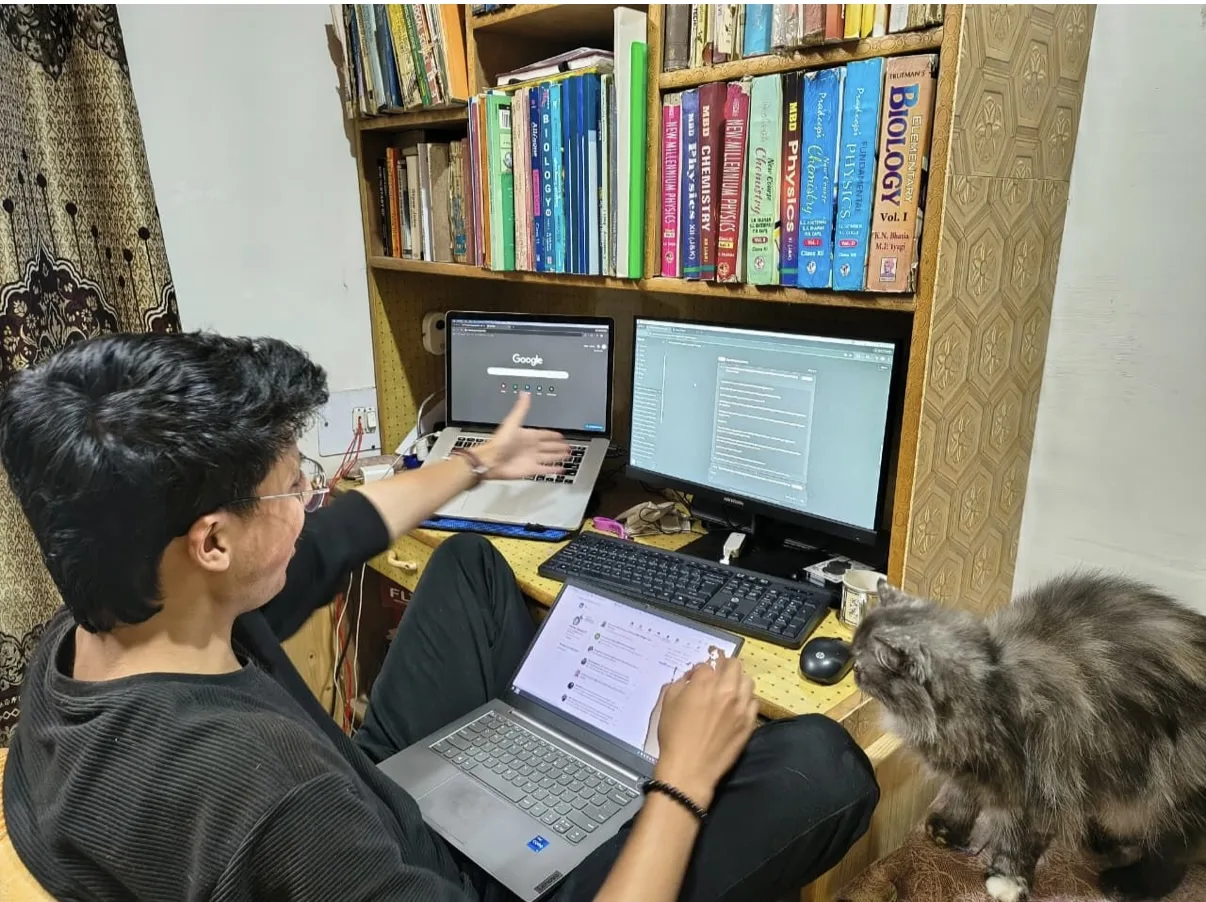
Eid was yesterday. Everyone rested today. I opened the laptop anyway.

Meetings. Portals. Spreadsheets. Code.

This is what my days look like, at home, at the office, it doesn't matter. The laptop comes everywhere. The work doesn't really stop.

Not because I have to. Because I can't imagine it any other way.

People ask what it takes to build a company from Kashmir with no funding, no ecosystem, no roadmap.

Honestly? It just looks like this.

A laptop. A quiet corner. Showing up every single day including the days you're supposed to be off.

The fiber running through Srinagar's neighborhoods — planned like this.

The NOC portal managing thousands of subscribers — built like this.

SuperDash, now being used by ISPs across India — designed like this.

No glass office. No investor backing. No perfect conditions.

Just a 21-year-old who decided to build something that didn't exist yet and hasn't stopped since.

Day 24 of my 30-day build-in-public series.

Marketer's tip of the day: Consistency is not about discipline. It's about caring so much about what you're building that stopping feels worse than continuing.

Find that thing. Then don't stop.
BuildInPublic Founder Kashmir ViberNet OpenLoop StartupLife Entrepreneurship

Day 25: Custom SaaS for ISPs

Campaign Day 25
Day 25: Custom SaaS for ISPs - Build in Public Campaign by Mehran Shahmiri in Kashmir

Today is Day 25 of my 30-day build in public series, and I'm writing Today's post myself without using AI. Yeah, I used up my weekly limit 😭

This post is not exactly about ViberNet (our ISP) or Open Loop (our software agency). It's about SuperDash, a byproduct of both I would say.

SuperDash is an all-in-one software for ISPs. It handles billing, accounting, customer management, and more.

We originally built it for our own setup because we couldn't find software that properly fit our tools and hardware stack. Most ISPs have to adjust their workflow around generic software instead of using something made for them.

That's when I realized there's a real gap in the market.

So now, we want to provide custom software as a service for ISPs, where we handle the full tech stack and backend, from billing and accounting to basic network management, while ISPs can focus on running and growing their business.

If you want something custom built for your stack, infrastructure, and operations, SuperDash is for you. Feel free to DM me or email me at ms@openloop.in.

Day 26: Operational Complexity

Campaign Day 26

If your business has real operational complexity, this post is for you.
A direct conversation about what we do at Open Loop and who we do it for.

We build operational software for businesses that have outgrown their current tools.

Not websites. Not apps for the sake of apps.

The system that replaces the WhatsApp group running your operations. The database that replaces the Excel sheet three people are editing simultaneously. The portal that replaces the manual process your best employee does from memory because nothing exists anywhere else.

We've built:

  • → A full ISP management stack, billing, RADIUS, onboarding, OLT monitoring, customer app, franchise management
  • → Customer portals with integrated payment flows
  • → Enterprise platforms with GPS tracking, asset management, HR systems
  • → Automation that eliminates hours of daily manual work permanently

Everything we sell, we've already built and even run ourselves at ViberNet.

That's the difference. We don't guess what operational software needs to do. We operate it every single day.

Who this is for:
A business owner or operations manager whose team is working around broken processes daily. Someone open to investing $$$ if the ROI makes sense. Someone ready to move in the next 60 days.

Who this is not for:
Anyone looking for the cheapest option. Anyone without a defined problem. Anyone who wants a website.

If that's you, I'd like to talk.

Not a sales call. A straight conversation about your problem and whether software solves it.

DM me or write to ms@openloop.in

Day 26 of my 30-day build-in-public series.

Marketer's tip of the day: The most effective sales content is ruthlessly specific about who it's for and who it isn't.

Trying to appeal to everyone is the fastest way to appeal to no one.

Say exactly who you want. The right people will find you. The wrong ones will filter themselves out.

That's not exclusion. That's efficiency.
OpenLoop CustomSoftware BusinessAutomation BuildInPublic SoftwareAgency Founder

Day 27: The Big Vision

Campaign Day 27
Day 27: The Big Vision - Build in Public Campaign by Mehran Shahmiri in Kashmir

I'm 21. I run a fiber ISP and a software agency in Kashmir. And I think we're sitting on something much bigger than both.

Kashmir sits at the geographic heart of North India.

Himalayan winters that make natural cooling effortless, the kind data centers in Delhi and Mumbai spend crores achieving artificially.

Strategic position for peering infrastructure. The natural backbone for a region urbanizing faster than its digital infrastructure can keep up with.

Nobody is building this here yet.

That's not an observation. That's the opportunity.

ViberNet started as a fiber ISP. But fiber is just the foundation.

The same infrastructure delivering internet to homes in Srinagar can anchor data centers serving the entire north. The same network connecting our subscribers today can become the peering point every serious operator in the region needs tomorrow.

And the software we're building at OpenLoop, AI monitoring, self-healing network intelligence, that's not just agency work.

That's the operating system for the next generation of regional internet infrastructure.

Two years ago this was a vision in a room nobody was watching.

today it's fiber in the ground, software in production, and a product being used by ISPs across India.

The foundation is real.

What gets built on top of it is what keeps me up at night, in the best possible way.

If you see what I see, you know where to find me.

Day 27 of my 30-day build-in-public series.

Marketer's tip of the day: Vision without proof is just talk. Proof without vision is just execution.
The combination of both, in the same person at the same time, is what stops people mid-scroll.

Day 28: In the Middle of the Struggle

Campaign Day 28
Day 28: In the Middle of the Struggle - Build in Public Campaign by Mehran Shahmiri in Kashmir

I haven't made it. I just want to be honest about that.
The money is tight. People are still doubting. Things still break at the worst possible times.

I'm not writing this from the other side of success. I'm writing it from the middle of the struggle.

But something is different now.

I remember my first ever sales call.

I was so nervous I could hear my own heartbeat. Somehow I closed it but my hands wouldn't stop shaking the whole time.

I used to dread talking to strangers. Every new conversation felt like something I wasn't ready for.

I'm still an introvert. That hasn't changed.

But today I can walk into a hard conversation and stay calm. I can absorb bad news without falling apart. I can have a crisis at 2am, fix it, and show up the next morning like nothing happened.

Nobody taught me that.

Doing hard things every single day taught me that.

People see “21 year old running two companies in Kashmir” and assume confidence came naturally.

It didn't.

It was built. Slowly. Painfully. One uncomfortable situation at a time.

I'm still building it.

Entrepreneurship didn't make me wealthy, yet. It made me harder to break.

Right now, that's enough.

Day 28 of my 30-day build-in-public series. Two more to go.

Marketer's tip of the day: People don't go viral for being successful. They go viral for saying out loud what everyone else is quietly feeling.

Say the real thing. Always.
BuildInPublic Founder Kashmir ViberNet OpenLoop Entrepreneurship StartupLife

Day 29: What Actually Happened

Campaign Day 29
Day 29: What Actually Happened - Build in Public Campaign by Mehran Shahmiri in Kashmir

29 days ago I started posting every day about ViberNet (our ISP) and Open Loop (our software agency). Here's exactly what happened.

No paid promotion. No boosted posts. Just showing up daily and being honest about what I'm building.

The numbers:

  • → 87,000+ impressions
  • → 36,500+ unique people reached
  • → 1,552 engagements
  • → 128 comments
  • → Top post: 51,000 impressions; from a 1,600 follower account

But the numbers aren't the point.

Here's what actually happened:
Strangers started DMing me about their businesses. ISP owners reached out about SuperDash.
Business owners described operational problems and asked if we could solve them. People from cities I've never visited started following a 21-year-old building an ISP in Kashmir.

That didnt exist 29 days ago.

The surprising part:

  • My posts with 10,000+ impressions didn't bring a single inbound lead.
  • My posts with 800 impressions brought real business conversations.

But it made complete sense.

Viral posts reach everyone. Everyone includes almost nobody who needs what you offer.
Specific posts reach fewer people, but the right people. The ones who read it and think “this person understands exactly what I'm dealing with.”

That's the person who sends the DM.

Reach is vanity. Relevance is the business.

What else I learned:
Specificity travels. My most detailed, most honest posts outperformed every vague one.

Consistency beats virality. 29 days of showing up did more than any single post could.

Honesty is a strategy. Posts where I admitted failure or doubt got more genuine responses than any achievement post.

Build in public works. Not because it's a content strategy. Because people trust what they can watch being built in real time.

One day left.

Tomorrow I'll tell you what comes next.

Day 29 of my 30-day build-in-public series.

Marketer's tip of the day: Stop chasing impressions. Start chasing relevance.
The right 300 people are worth more than the wrong 300,000.

Know exactly who you're writing for. Write only for them. Let everyone else scroll past.
That's the content strategy nobody teaches, because it doesn't make for impressive vanity metrics. But it makes for real business.
BuildInPublic LinkedInGrowth ViberNet OpenLoop Founder Kashmir Entrepreneurship

Day 30: The Finale

Campaign Day 30
Day 30: The Finale - Build in Public Campaign by Mehran Shahmiri in Kashmir

Today is Day 30/30 of my build in public series.
I said I'd show up every day for 30 days. I did.
That's it. That's the whole win.

30 days ago I was a 21 year old building an ISP in Kashmir that most people hadn't heard of.

Today I'm the same 21 year old. Still in Kashmir. Still building.

But 110,000 people watched me do it.

Here's where everything stands:

ViberNet is expanding. New areas. New partners. More fiber in the ground.
Open Loop is closing clients. Solving operational problems for businesses with software.
SuperDash is live. If you run an ISP, you already know where to find us.

Takeaway from this 30 day series:

  • My posts with 10k impressions brought zero leads.
  • My posts with 300 impressions started real business conversations.
  • Turns out the right 10 people matter more than the wrong 10,000.

I'll never forget that.

I'm not stopping posting. I'm just stopping the series.

Tomorrow looks the same as Today, wake up, open the laptop, build.

The only difference is I'm less nervous doing it out loud now.

To everyone who read, commented, or just quietly followed along, thank you. Really.
You didn't have to. You did anyway.

This isn't an ending.

It's just what day 31 looks like without a number on it. See you Tomorrow.

Final marketer's tip: You don't need a perfect strategy. You need to start and not stop. That's the whole thing. I promise.
BuildInPublic Day30 ViberNet OpenLoop SuperDash Kashmir Founder